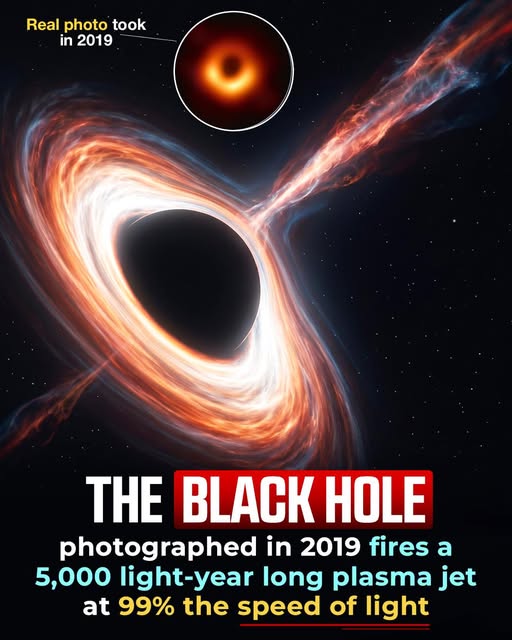
The black hole at the center of galaxy M87, famously photographed in 2019, powers a colossal jet of plasma stretching about 5,000 light-years into space.

The jet is made of charged particles launched from the region around the black hole, rather than matter escaping from inside the event horizon.
 Astronomers have measured particles in the jet moving at more than 99% of the speed of light. Relativistic effects can even make parts of the jet appear to move faster than light, but the particles themselves do not violate the cosmic speed limit.
 M87* is a supermassive black hole with a mass of about 6.5 billion Suns, located roughly 55 million light-years from Earth. The Event Horizon Telescope released its historic image on April 10, 2019.
 The jet is believed to be powered by the extreme environment around the black hole, where superheated gas and intense magnetic fields help launch and accelerate the plasma outward at extraordinary speeds.
How a Tiny Push Can Save Earth
What if we could stop an asteroid from hitting Earth without destroying it?
It sounds like science fiction, but the basic idea is surprisingly simple.
An asteroid traveling through space follows a predictable path. If scientists detect one on a collision course early enough, a spacecraft could intercept it and give it a tiny push.
That push might change the asteroid’s speed or direction by only a very small amount.
At first, the difference would be almost impossible to notice.
But here’s the key: space is enormous, and the asteroid may have years or decades before reaching Earth.
That tiny change has more and more time to accumulate.
By the time the asteroid reaches the point where it would have crossed Earth’s orbit, its position could be thousands or even millions of kilometers away from the original trajectory.
Instead of hitting Earth, it simply passes by.
This is called asteroid deflection, and NASA has already demonstrated the basic principle.
In 2022, NASA’s DART spacecraft deliberately crashed into the asteroid moonlet Dimorphos and successfully changed its orbit.
The goal wasn’t to destroy the asteroid.
It was to prove that humanity can change the motion of an object in space.
And that’s the incredible part:
Sometimes, saving Earth may not require a giant explosion.
It could take nothing more than a carefully calculated push—delivered early enough
What if we could stop an asteroid from hitting Earth without destroying it?
It sounds like science fiction, but the basic idea is surprisingly simple.
An asteroid traveling through space follows a predictable path. If scientists detect one on a collision course early enough, a spacecraft could intercept it and give it a tiny push.
That push might change the asteroid’s speed or direction by only a very small amount.
At first, the difference would be almost impossible to notice.
But here’s the key: space is enormous, and the asteroid may have years or decades before reaching Earth.
That tiny change has more and more time to accumulate.
By the time the asteroid reaches the point where it would have crossed Earth’s orbit, its position could be thousands or even millions of kilometers away from the original trajectory.
Instead of hitting Earth, it simply passes by.
This is called asteroid deflection, and NASA has already demonstrated the basic principle.
In 2022, NASA’s DART spacecraft deliberately crashed into the asteroid moonlet Dimorphos and successfully changed its orbit.
The goal wasn’t to destroy the asteroid.
It was to prove that humanity can change the motion of an object in space.
And that’s the incredible part:
Sometimes, saving Earth may not require a giant explosion.
It could take nothing more than a carefully calculated push—delivered early enough