
 ] [Read more :
The James Webb Space Telescope is exposing a universe that became massive, violent, and surprisingly complex far earlier than many astronomers expected. By collecting infrared light that has traveled for more than 13 billion years, Webb is observing galaxies as they appeared only a few hundred million years after the Big Bang—and some of them already contain brilliant, rapidly feeding black holes. Under conventional models, the first stars and galaxies should have developed gradually as gravity pulled primordial gas into increasingly large structures.
Yet Webb has identified numerous early galaxies that appear brighter, more chemically developed, or more massive than predicted by some simulations. Spectroscopic measurements have also uncovered actively growing black holes during this young cosmic era, raising a profound question: how did these objects become enormous in such a short time? A black hole formed from the collapse of an ordinary massive star would need to consume matter at an extraordinary rate to reach millions or billions of solar masses so early. Astronomers are therefore investigating whether the first “seeds” were much heavier than expected, possibly forming when enormous clouds of gas collapsed directly without first becoming normal stars.
Another possibility is that early black holes experienced episodes of super-Eddington accretion, temporarily feeding faster than the theoretical rate at which radiation should push infalling material away. Webb has detected compact red sources—often called “little red dots”—that may represent young galaxies containing hidden, rapidly growing black holes. However, researchers caution that the properties of these objects remain under investigation. Dust, intense star formation, and active galactic nuclei can produce overlapping infrared signatures, meaning that brightness alone cannot provide a reliable measurement of mass.
The “terrifying truth” is not that Webb has photographed a cosmic explosion approaching Earth or discovered evidence that the universe is suddenly collapsing. It is that black holes may have influenced the formation of galaxies almost from the beginning, unleashing radiation, winds, and jets capable of heating gas and controlling where new stars could form. These processes may have shaped the architecture of the cosmos long before our Sun or planet existed.
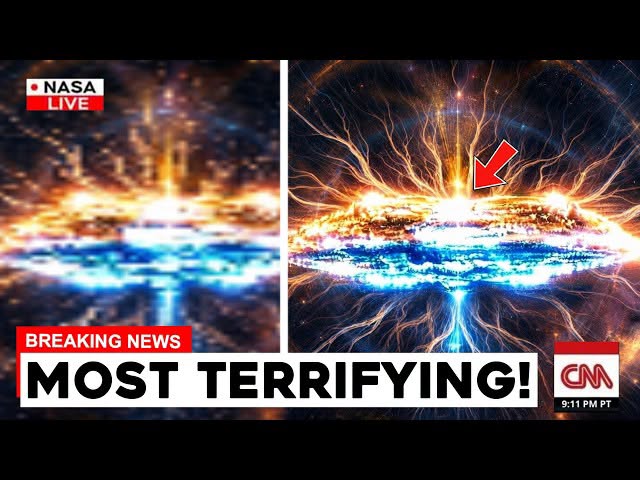
The accompanying thumbnail presents this idea as a glowing disk surrounded by energetic filaments, but it is a stylized illustration rather than a genuine Webb observation, and the phrase “MOST TERRIFYING!” is promotional language rather than a NASA warning. None of the distant objects studied by Webb poses a danger to Earth. Their light began traveling toward us billions of years before humanity appeared, and many have likely changed completely since then. What makes the findings unsettling is their challenge to human assumptions: the universe may have organized itself into stars, galaxies, and enormous black holes with a speed and efficiency our existing models do not yet fully explain.
Scientists are now refining estimates of stellar mass, testing alternative black-hole formation scenarios, and gathering spectra from larger samples. Webb has not disproved the Big Bang or broken cosmology, but it has made the early universe look far less simple—and far more extreme—than the quiet cosmic dawn astronomers once imagined. More information about Webb’s study of the first galaxies is available from the