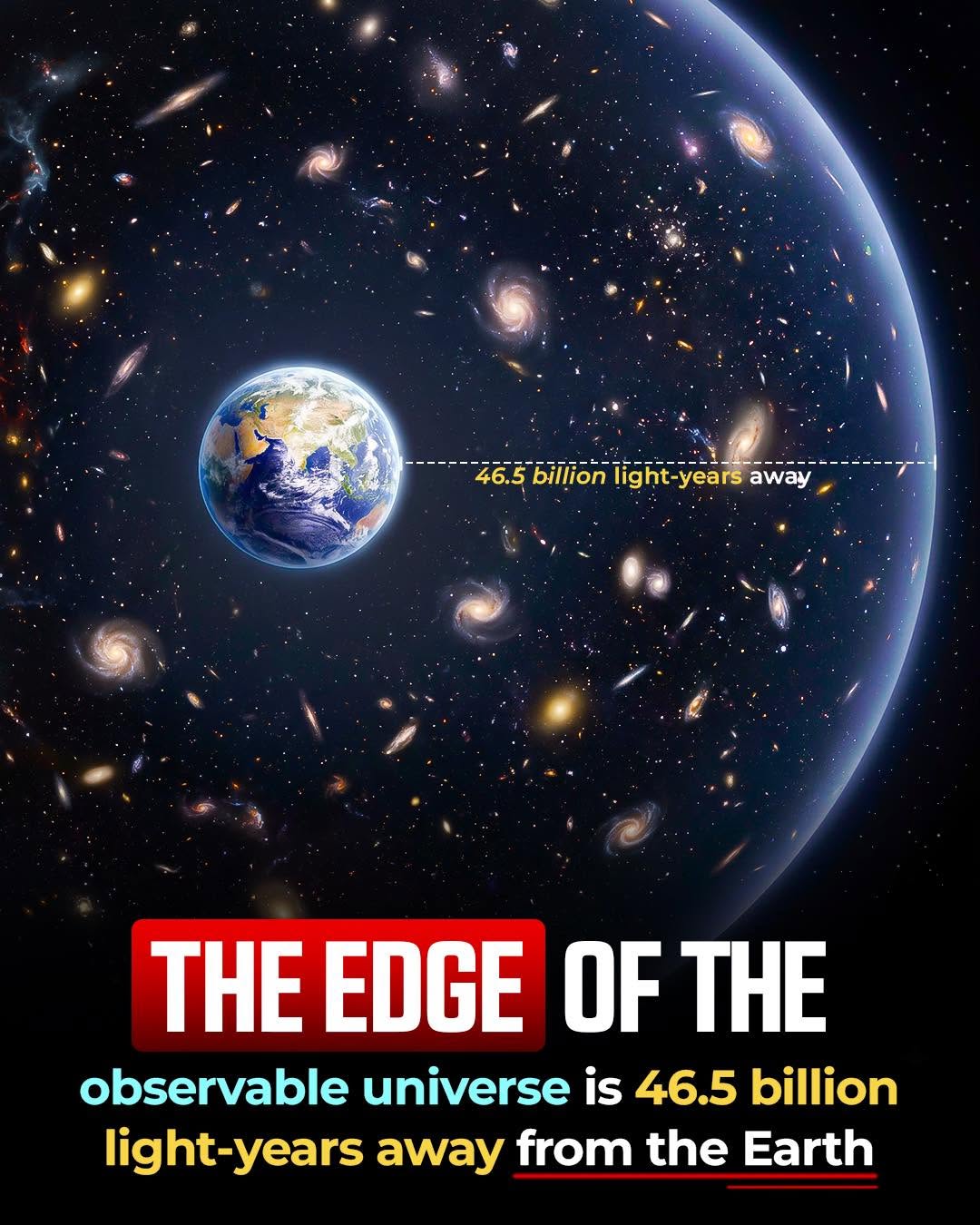
The universe is about 13.8 billion years old, but the observable universe is roughly 93 billion light-years across. That may seem impossible at first, because light has only had about 13.8 billion years to travel.
⸻
 The key is that space itself has been expanding while that light was traveling. The ancient light reaching our telescopes today began its journey when the universe was much smaller, but the regions that emitted it have continued moving away as space expanded.
⸻ Today, the most distant observable regions are estimated to be about 46.5 billion light-years away in every direction. This gives the observable universe an approximate diameter of 93 billion light-years.
⸻ Those numbers do not represent a physical edge. The ~46.5-billion-light-year distance marks an approximate particle horizon—the greatest present-day distance from which light could have reached us since the beginning of cosmic history.
⸻ And the observable universe may be only a fraction of the entire universe. We don’t currently know whether the universe is finite or infinite, or how much larger it extends beyond the region we can observe.
The universe is about 13.8 billion years old, but the observable universe is roughly 93 billion light-years across. That may seem impossible at first, because light has only had about 13.8 billion years to travel.