They say planet formation’s a cruel endeavor

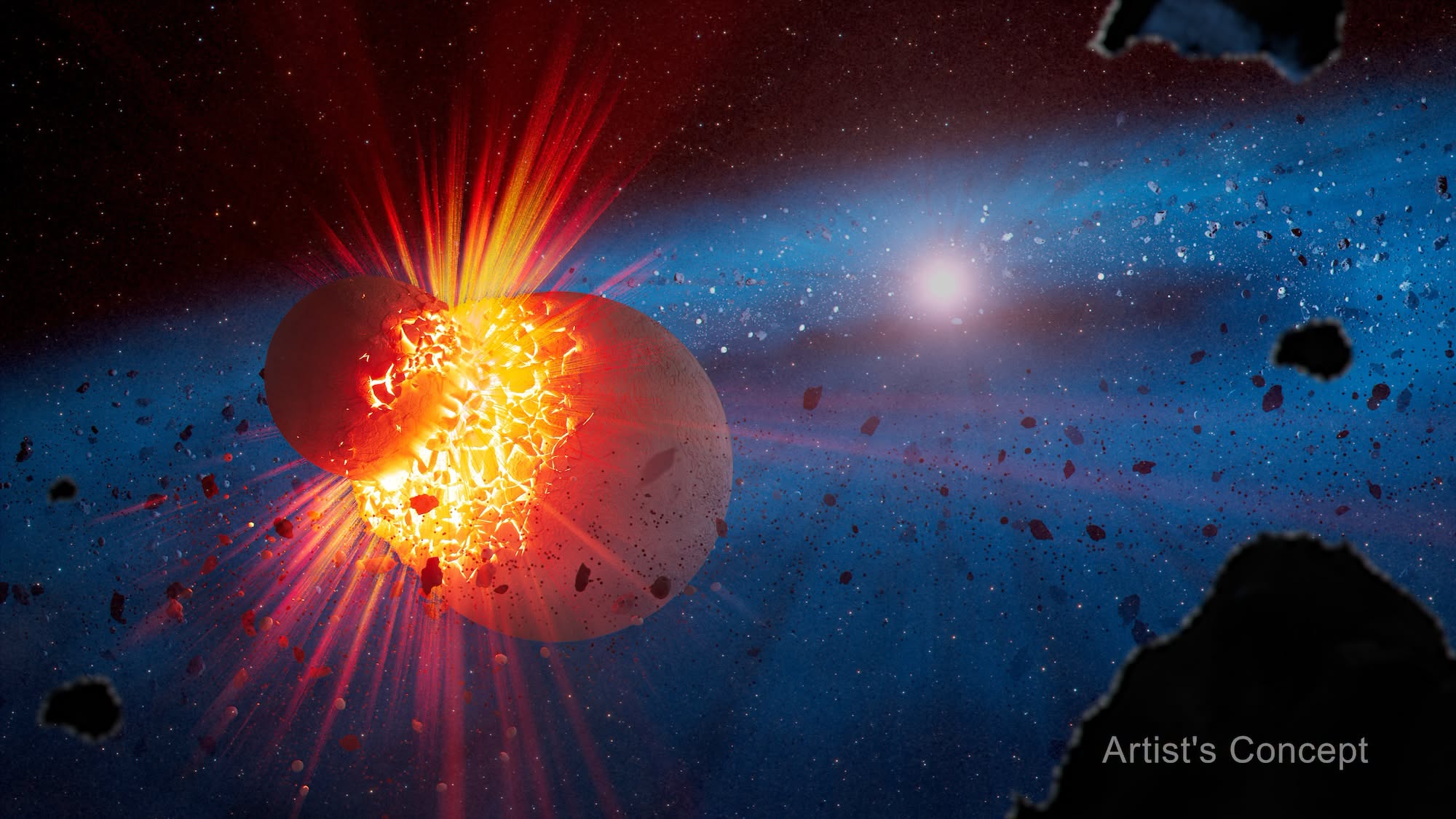
Violent collisions, like that between a proto-Earth and a Mars-sized object named Theia 4.5 billion years ago, shaped our home planet. Webb is helping us compare other young stellar systems to the history of our own.
As a star ages, the environment surrounding it changes. The material in its gas-rich protoplanetary disk form planetesimals, which can then combine and break apart to create planets and moons, eventually leaving a gas-poor disk of leftover debris. These debris disks are analogs to the debris in our own solar system, namely our asteroid belt and Kuiper belt.
Some stars have large amounts of warm dust close-in, that are very bright in the infrared – a rare subclass called “extreme debris disks.” The retired infrared Spitzer Space Telescope discovered these objects, and Webb took a closer look using its powerful infrared sensitivity. Webb confirmed several key things: that extreme debris disks have smaller dust grains than in protoplanetary or classic debris disks; a high concentration of warm dust; and vary irregularly in brightness.
Some of these disks are rich in silica and some are poor, and which category an extreme debris disk belongs to speaks to the type of collisions that produced the debris. Silica-rich disks seem to be produced by high-energy impacts between Mars-sized bodies around younger stars. Silica-poor ones might be formed by smaller scale collisions across a range of ages, and often show greater variability in their brightness, probably due to how the debris is being produced by multiple impacts.
Bringing this back to home, our own solar system might have experienced more than one extreme debris disk phase, like when the Earth, with its silica-rich crust, was formed by a giant collision. The gas giants migrating outward may have disrupted smaller bodies, generating the dust-rich conditions we observe in extreme debris disks. Understanding how our rocky planets formed and how the giant planets evolved help us to bring the bigger picture into clearer view.
Read more at the link in the comments.
Artwork credit: NASA, ESA, CSA, Joseph Olmsted (STScI)